Develop a new way to study local blade-bearing behaviour during prolonged testing without the large-scale setup required for a complete bearing.
DIS Systems developed both the test method and compact rig, combining up to 500 kN loading with lubrication, particle monitoring, filtration and customer data logging.
A targeted section-test method with proven long-term operation, new test insight and repeat equipment delivery after the first rig proved successful.
Production context, equipment design, scope of delivery and verified customer value.
Siemens Energy wanted a new test method that could generate detailed insight into the behaviour of a blade-bearing section without requiring the large-scale equipment and test setup needed for a complete blade bearing.
The objective was to isolate the test to a single bearing ball and a segment of the raceway, making it possible to observe what happens locally during prolonged testing. Developing the method therefore required close collaboration with key customer stakeholders before the equipment itself could be defined.
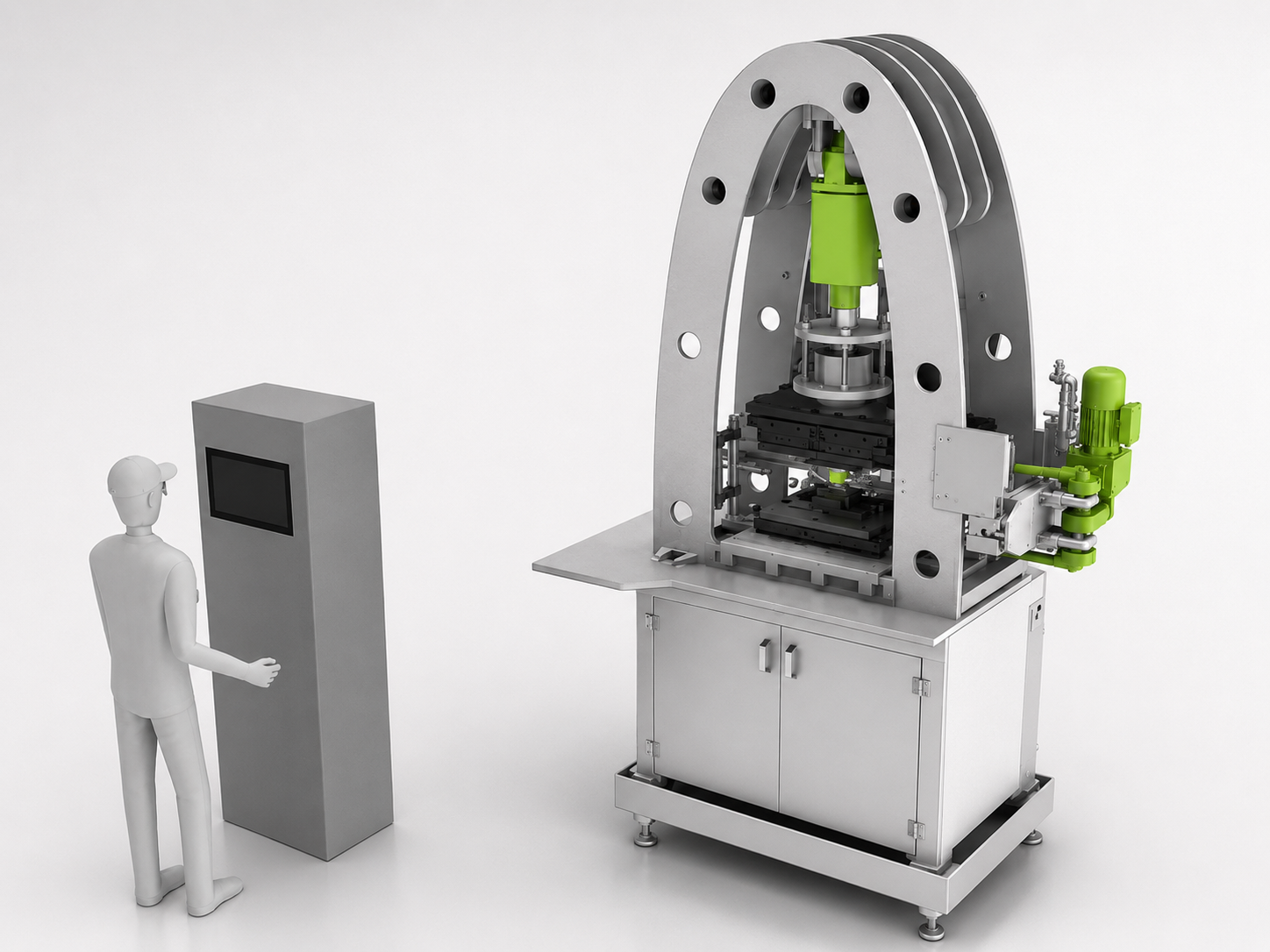
DIS Systems worked with Siemens Energy to develop the test method and translate it into a compact test rig for prolonged testing of a single bearing ball and raceway segment.
The rig is designed to apply forces of up to 500 kN and combines the mechanical test setup with the supporting hydraulic, lubrication, control and data interfaces required for long-duration operation.
An integrated oil-lubrication circuit provides oil collection, particle sensing, filtration and recirculation. A separate hydraulic power station and control cabinet support the test setup, while an integrated central greasing unit is included for longevity testing. The machine also interfaces with the customer’s data-logging system so test data can be captured within the customer’s existing environment.
Before delivery, DIS Systems carried out the first tests on the rig over an extended period, providing an opportunity to verify the equipment and test method under prolonged operating conditions.
SCOPE OF DELIVERY
Development of the new test method
Concept development and detailed requirements
Mechanical, electrical, hydraulic and control engineering
Manufacture, assembly and functional testing
Factory Acceptance Test (FAT)
Installation and commissioning
Site Acceptance Test (SAT)
Remote and onsite service
The compact section-test approach gives Siemens Energy a way to investigate a single ball and raceway segment without using the full-scale equipment associated with testing a complete blade bearing.
Test method development, Requirements definition, Mechanical engineering, Electrical engineering, Hydraulic engineering, Control system engineering, Oil lubrication and recirculation, Particle sensing and filtration, Central greasing, Hydraulic power unit integration, Customer data logging interface, Manufacture and assembly, Functional testing, FAT, Installation and commissioning, SAT, Remote and onsite service
Built by DIS Systems. Backed by DIS/CREADIS.